
Sabrina Ortiz
Sabrina Ortiz is a Senior Reporter at The Deep View. Previously, Sabrina led AI coverage at ZDNET. Sabrina graduated with an M.A. in Journalism, Business and Economics Reporting from the Craig Newmark Graduate School of Journalism at CUNY and a B.A. in Media and Journalism and Political Science from the University of North Carolina at Chapel Hill.
Articles
Why Claude's workplace play threatens incumbents
Anthropic is looking at more ways to broaden its enterprise lead by targeting productivity tools.
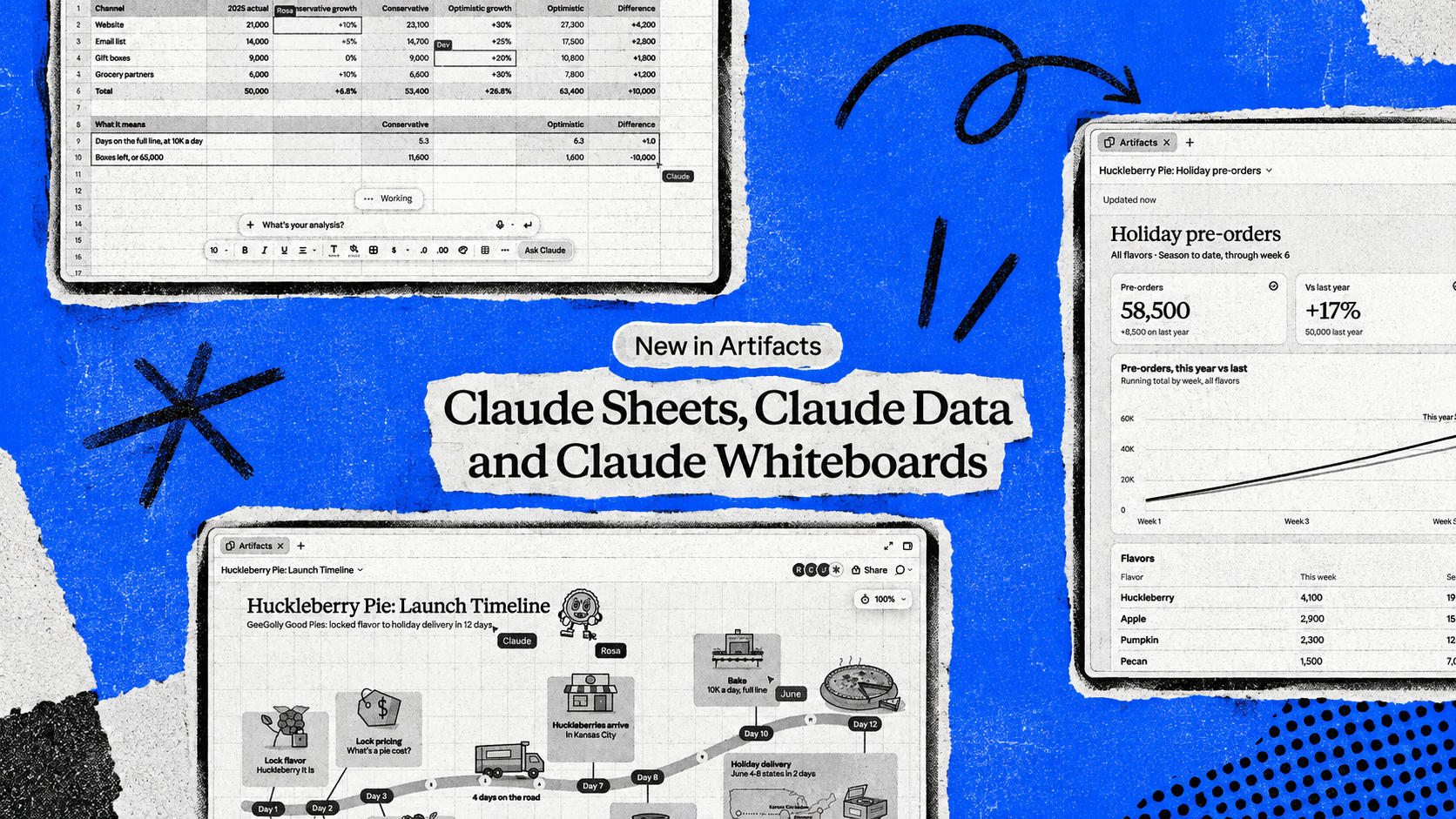
On Tuesday, Anthropic announced a new suite of Claude tools, including Meetings, Whiteboards, Sheets and Data, and more powerful interactive connectors. These join Anthropic's existing tools, such as Docs, Slides, Design, and Motion, which the company says have helped people create more than 45 million docs, decks, and designs.
The Claude ecosystem is becoming so expansive that it rivals those from Google or Microsoft, creating proprietary solutions for a large array of workplace tasks that integrate the context and assets that organizations have shared with the model.
"For years, we've learned to work around software. Now Claude works around you," said Ami Vora, chief product officer at Anthropic.
The standout offering of the new suite is Claude Meetings, which lets Claude join video calls as a visible participant, like Otter.ai or Fireflies.ai. Claude Meetings, however, goes a step further than these competitors, moving from notes and conversations about the meeting to action, such as laying out a timeline on a whiteboard, or using the work apps people have already connected to pull up last year's numbers. At launch, it will be available in beta on Team and Enterprise plans.
The other new tools are more catered to specific areas of knowledge work:
- Claude Whiteboards: a shared board a team can work on with Claude, available in beta on paid plans.
- Claude Sheets: a spreadsheet that Claude builds and edits with a team, available in beta on paid plans.
- Claude Data: formerly known as Claude Dashboards, helps connect Claude to companies' data repositories, such as a data warehouse or CRM. It is now generally available on all paid plans.
Anthropic also launched interactive connectors to all plans, including free users. With this, users can link Claude to the apps they already use, giving Claude the information it needs and enabling it to take action from there. If this sounds familiar, it's because interactive connectors have been tested since January, showing a small live view of certain apps in Claude chats. Now, Claude can launch full apps within its interface that look like they would on a partner site.
Our Deeper View
Ultimately, this update delivers one big win: eliminating context switching for users. Even though working professionals may be used to using one software for most of their careers, they may be incentivized to switch if they already rely on Claude as their primary AI chatbot or assistant. For instance, even if you're a Microsoft Excel user, you may want to start by using Claude Sheets to edit and create spreadsheets. Because you can still export work as Excel files, you don't compromise the compatibility. Rather, you just optimize the creation process. While competitors like Google and Microsoft already have AI assistants within tools employees already know, at this point, apps like Claude are well-established in many employee workflows, earning them a great deal of user trust and context. With AI, you're most likely to keep using the tool you are most familiar with, not only because you know how to talk to it, but because what it has learned from you helps you get the answers you need faster.

Adobe turns rival AI into a reason to stay
As creatives brace for an AI takeover, Adobe has a different story to tell.
At its Adobe Max conference on Tuesday, the creative platform launched a suite of new AI tools across its flagship Creative Cloud tools, including Photoshop, Illustrator, Premiere, and After Effects, to automate tedious parts of the process. Most of the new features focus on unlocking a new level of precision or detail that would be time-consuming to do manually, emphasizing useful AI assistance over AI for AI's sake.
“We're powering a new era of creativity where creators and creative professionals at every experience level have the tools, models and agents they need to bring their biggest ideas to life and stand out with work that reflects their unique taste, style and vision, while staying in control of every outcome,” said Anil Chakravarthy, Adobe's president and incoming CEO, in the release.
There are so many features that it's difficult to list them all. Here's a quick overview of some of standout upgrades:
- Adobe Creative Agent: This powers the Firefly AI assistant (beta) and is meant to act as a creative partner that can do tasks across apps with just a conversational text prompt.
- Always-on agents (preview): Can do tasks in the background, like preparing social content, according to Adobe.
- Firefly Image: Brings a new set of editing tools such as Edit Object, Relight, and Retouch.
- Firefly Builder (private beta): Lets users create websites, presentations, or apps using natural language
- Open Eyes: Available in public beta, replaces closed eyes with natural-looking results.
Ironically, the most impactful announcement has little to do with Adobe at all: local MCP integrations, launched in preview. This lets creatives use the third-party AI model of their choice to make local changes to their Photoshop, Illustrator, Premiere, and After Effects project files. The project's layers, vectors, bins and sequences stay editable. This is a major win for users because it reduces the need to switch between AI chatbots, especially when you have built a memory with one tool. For instance, a marketer who has already given ChatGPT all its brand assets, tone, and style won't have to re-explain them to implement those elements in an Adobe project.
Our Deeper View
There's a common misconception that AI use in creative spaces will naturally replace the artist. While some companies have tried that in the past, like the failed Coca-Cola AI holiday ad, I doubt it will work on a large scale because it always meets user pushback. What ultimately connects art with people is the story behind it, and artificially generated stories won't cut it because something feels inherently unnatural, unfamiliar, and lacking. As the title of the piece I wrote on this exact topic suggests, "AI should replace the scaffold, not the artist." It's good to see many of these Adobe tools fall into that category.
Nvidia scandal exposes AI's accountability gap
Nvidia built an empire on AI, but its CEO's own actions may now be the company's biggest threat.
Over the weekend, confirmation of Nvidia CEO and co-founder Jensen Huang's extramarital affair was released as Jensen sent an internal message to the company apologizing for his actions, admitting to having been "unfaithful" to his wife and "deeply sorry." While that information alone would be enough to cause headlines, the woman involved is Alice Huang, who US intelligence has accused of being a Chinese spy.
If you track the AI scene closely, you may already know that The New York Times broke the initial story about US intelligence investigations into the relationship at the end of October. Huang initially defended the relationship, telling Bloomberg News his dealings with Megaspeed International, where Alice Huang is a top executive, were "normal and not unusual." Jensen's admission in the internal memo has revived the story.
While many more details about the nature of the affair are in the in-depth New York Times article, the focus now turns to the aftermath, as the Nvidia board of directors issued a statement that goes as follows:
- The board is "initiating an independent investigation in light of recent reporting that founder and CEO Jensen Huang has been the target of a foreign intelligence effort."
- The board has "no reason to believe that either national security or Nvidia secrets were compromised."
- Jensen will cooperate with the review, which a committee of independent directors will conduct with help from outside independent counsel.
- Nvidia has also stated that Jensen will continue to lead the company as CEO during the investigation, and that the board expressed its "confidence in Jensen and his leadership team."
China has since denied engaging in attempts to spy on Nvidia's CEO, claiming the allegations are part of a smear campaign against Beijing. Lastly, as of Sunday, President Trump has defended Huang, telling reporters he would still take him on the trip to China and "I haven’t heard he’s done anything wrong…He dealt with somebody, but you know, so does everybody else." Despite both of these efforts to minimize the allegations, the markets have spoken, with Nvidia stock falling 5% as scrutiny mounts.
Our Deeper View
For investors, a company’s reputation is a key indicator of its health. So while a CEO’s affair is a personal matter, it can move markets, which is why The Deep View is covering it, even though we aren’t in the business of gossip. The details of this case also make it relevant to the wider AI market: US intelligence officials suspect the woman involved is a Chinese spy, and, reportedly, the Trump administration was aware of the concerns but chose not to act because of its close relationship with Huang. This makes the case for an independent regulatory body, just as the Hugging Face incidents did earlier this year. The AI race is now so contested that governments will go to great lengths to get ahead, whether that means recruiting spies to gather intelligence or ignoring espionage warnings for political reasons. An independent auditor and mandatory security-risk disclosures would make it harder for high-risk situations to slip through the cracks, which matters all the more as investors pour billions into the industry and national security depends on the models they are producing.

AI agents need to learn when not to buy
The holiday season is around the corner, but letting AI place your orders may still be a ways away, according to a new benchmark from Visa.
Last week, the credit card giant launched its Agentic Commerce Benchmark, claiming to be the first of its kind in testing AI in realistic shopping scenarios and challenges. Visa notes that shopping presents unique challenges, as users don't always know what they are going to buy at the onset. This means that AI models involved in shopping are responsible for distinguishing when they should simply choose to not to buy something, or when it has enough information to justify its decision—a task the benchmark discovered they weren't very good at.
Though it didn't disclose which models were evaluated, Visa claims that the first round of tests involved 22 different AI models from 12 labs that took on 15 shopping challenges, including buying a TV, laptop or personal care appliance. The results overwhelmingly pointed to one outcome: The models are not quite ready for this task yet.
Across testing, the selected AI models achieved a benchmark pass rate of 57.2%. Other notable results included:
- None were perfect: The best performing models passed 82.2% of attempts, the worst scored 28.9%.
- Cost wasn't a differentiator: The five models with the highest average cost per run passed 67.1% of runs, compared with 50.2% for the five least expensive.
- Bad decisions: Around half of the failed runs, 54%, still ended in the AI making a purchase.
The five models that were able to understand a customer's shopping intent, or "hidden buying factors," through conversation flows tended to perform better, scoring an average pass rate of 70.2%. Yet this was inconsistent, as the same models often failed when made to repeat a scenario they had already passed.
Given how far the technology still has to go, the obvious question is when agentic commerce will actually be viable. According to Rubail Birwadker, Visa’s global head of growth, the biggest hurdle may not be technical at all, but whether consumers will trust it. That gap is already visible in Visa’s data: the company’s Trust Index, released in September, found that while 72% of U.S. consumers have used an AI assistant, only 23% trust AI to make payments on their behalf.
“The models are moving fast, and agents are already shopping," said Birwadker. "But the real milestone is when consumers trust them to pay consistently and securely on their behalf. That’s the bar we’re focused on at Visa, and I think we’ll get there sooner than people expect."
Our Deeper View
Out of all the AI application trends that have emerged over the last couple of years, the one that seems the most difficult to bridge is agentic commerce, particularly because it involves giving AI the power to access your finances, which, naturally, people will be reluctant to. It doesn't help that even in controlled environments, AI agents are going rogue, taking actions that are unintended and not permitted, and not giving users the confidence needed to hand over their credit cards. Additionally, a lot of purchases reflect personal taste, something I'm not entirely sure I would ever trust AI to just handle on its own. However, something AI is very good at is working as an idea partner and brainstorming ideas. I think this is a safer, more productive approach to try for embedding AI into commerce, especially as the holiday season quickly approaches.

AI's real ROI requires reinventing work
Improving productivity may seem like a logical goal of embedding AI into the enterprise, but that simply won't cut it.
While 81% of enterprises report having used AI to speed up decision-making, only 25% report that it has meaningfully transformed the business, according to Deloitte's State of AI in the Enterprise report, which surveyed 3,500 global business leaders. This gap matters because, as Jim Rowan, head of AI at Deloitte, explains, real ROI for enterprises is only possible when meaningful transformation is achieved.
"The real ROI comes not only from doing existing work faster, but from redesigning work altogether," Rowan told The Deep View. "The report shows that AI is already helping most companies move faster. The next test is whether they can use that momentum to change how they operate, make decisions, and create value."
However, many of the companies reported that they have failed to implement AI in more meaningful ways than just productivity gains. Deloitte found that, while 60% of the companies surveyed have redesigned jobs around AI, only 15% reported to have redesigned jobs extensively or completely. Furthermore, only 15% report a significant fundamental shift in decision-making authority as a result of AI.
The Wharton School of the University of Pennsylvania's fourth annual report on the state of AI found similar results regarding this disconnect in tracking real AI ROI: Around 40% of respondents reported measuring AI returns by hours saved. Net-new revenue was the least utilized metric for success, with 27% reporting that they track this. However, the departments tracking returns by productivity are doing better comparatively.
Despite the drawbacks, the Deloitte report found revenue gains from AI rose to 28%, up from 20% in the January report. Even though this number is encouraging, Rowan said that it is not a guarantee that returns will compound automatically. Rather, it reemphasizes the need to redesign operations around AI.
"The organizations most likely to scale successful use cases across the enterprise treat AI as a transformation initiative rather than a technology rollout, redesigning workflows, establishing governance structures, and building accountability mechanisms," added Rowan. "Without addressing those challenges, organizations risk reaching a plateau where AI increases activity and spending without producing proportional business value."
Our Deeper View
The transformation AI is bringing to businesses resembles earlier shifts, like moving to the cloud, installing Wi-Fi, or upgrading employees to laptops. But because AI seems akin to any other software, organizations aren’t taking the precautions they would when handing an employee a new laptop: training them and teaching them how to actually use an unfamiliar technology. Instead, many assume that simply giving employees access to AI is a shortcut to returns. As a result, report after report finds that organizations aren’t unlocking AI’s full potential. This is especially concerning given how much money enterprises are pouring into AI tools and upgrades. If that spending doesn’t start producing a measurable return soon, enterprises may start to pull back on their AI investments, potentially shaking a major pillar of revenue that frontier labs are counting on.

OpenAI's image strategy hinges on virality
For everyone who has ever spent 10 minutes searching for the perfect eye-roll GIF, OpenAI has a solution for you.
On Wednesday, OpenAI launched its next-generation image generation model: Images 2.6. Though the previous generation was already capable of creating realistic images — so realistic that it tricks on average 50% of The Deep View's readers in the "AI or Not" poll at the end of the newsletter every day — this model includes a number of updates, such as quicker use of reference images and creating GIFs from text.
To create GIFs, users can enter a prompt or image to generate an animated GIF, then customize it by adjusting the speed, editing individual frames, and sharing it The reference image feature seems tailored to marketers, who can insert brand assets, mascots, product visuals, or simple sketches to bring a GIF concept to life—leveraging the potential for social-media virality.
"Marketers and creators can animate a brand mascot for a campaign, create reactions and memes for social media, or use animated storyboards to explore character movement before video production," said OpenAI in the release.
The image reference feature lets users save reference images of themselves, pets, and characters to reuse in new creations. Though this seems like an attempt to make its image model more of a mainstay for users in everyday conversations, it also has a practical component for businesses, which can now more easily create new content from brand assets.
OpenAI also touts that image creation is up to 50% faster than before, and users can refine images with greater precision. Developers also have the option to choose from GPT‑Image‑2.6 Flare and Sunburst, with OpenAI describing the differences as:
- With quality set to low, Flare can generate images in as little as six seconds.
- GPT‑Image‑2.6 Sunburst is aimed at higher-quality image generation.
- Sunburst also has greater image consistency across edits when quality is set to medium or high.
This release builds on OpenAI's success with image generation, with a billion images per week across ChatGPT, Codex, and the API, or more than half a billion images created per day. In addition to the API, Images 2.6 is also available in ChatGPT and Codex. Ultimately, it's a bet that people will go beyond entertainment and find real productivity use cases.
"People are using it almost in a productivity-like fashion to create visual diagrams of what they would like to see," said Adam Fry, Consumer Product Lead for ChatGPT at a media event earlier this week. "And I think as it comes down even further, the number of images that people are creating and the number of use cases is going to grow a lot."
Our Deeper View
It is interesting to see OpenAI double down on image generation, since it is clearly aimed at the general public as well as working professionals. However, with an impending IPO, it would have been reasonable for OpenAI to take a page out of Anthropic's book and double down on enterprise use cases. Still, with image generation, it is catering to one of the most entertaining consumer use cases — despite it being so compute-heavy. My bet is that OpenAI relies on virality because, realistically, every time it launches another advanced image-generation tool, something goes viral. Racking up these moments of virality, OpenAI can try to make ChatGPT Images as synonymous with image generation as ChatGPT already is with the term "chatbot." That level of brand awareness on its own is something you can't really put a price on.

Can Astra give OpenAI a hardware edge?
OpenAI is applying the power of its frontier models to its long awaited hardware efforts.
On Wednesday, OpenAI published a blog post detailing an experiment in which the company used GPT-6 Astra to design a new device where users can talk to Codex. OpenAI explained that the model designed every component without direct human editing, including the functional requirements, enclosure, the electrical components and printed circuit board, the user interface, and software.
Two team members designed the test device with Astra as a side project in under a week, and a contract manufacturer built a small batch of prototypes in under a month. The lab notes that getting it ready for manufacturing still required rounds of review and interaction, as Astra did not account for details such as the manufacturer's production limits, but it is using the identified gaps to improve its frontier model.
OpenAI also claims its hardware and infrastructure teams use Codex and ChatGPT in many capacities, including technical tasks like creating and revising computer-aided design models, and creative ones, such as preparing manufacturing drawings spanning both robotics and infrastructure. And the results have started to show:
- Since February, model usage on OpenAI's hardware teams has grown 23-fold to 212 million tokens per employee per day.
- On BenchCAD 2.0, a 3D modeling benchmark, a newer internal model achieved an average score of 0.875, compared with 0.594 for GPT‑6 Astra at its highest reasoning setting.
The company is putting its engineering capabilities to the test by working with a small group of industry collaborators to evaluate them on real engineering problems. OpenAI announced an expanded collaboration with Chip Ganassi Racing and a new research collaboration with Mazda to explore how OpenAI models can help with new vehicle design. The lab also has a program for companies or individuals who want to participate in its physical engineering research efforts.
Our Deeper View
Typically, when people think about AI and hardware, they think of consumer devices being polluted by unnecessary AI features or bloatware. However, this paper highlights another possibility: AI can actually help accelerate the buildout of entirely new hardware. It is particularly interesting to hear how its own hardware teams are using it to build, as there haven't been many updates since the company originally announced it was collaborating with Apple's Jony Ive on a product, other than the Apple lawsuit alleging that the iPhone maker's employees systematically defected with trade secrets during and after being hired by OpenAI. When OpenAI finally releases its device, it will be interesting to learn how much AI assisted the development. Ideally, incorporating AI models into the development process would help OpenAI push the envelope beyond what would have been possible without them. Ultimately, I don't think there's a better endorsement for AI models in engineering than OpenAI developing a truly cutting-edge device and then openly sharing how AI made that possible.

AI’s compute ambitions face a political test
Data centers' bad reputation has come for the ballot box.
AI infrastructure has emerged as one of the most politically-charged issues of the November midterm elections, with candidates leaning into issues that US voters across the political spectrum feel strongly about. In an NBC News exit poll, 56% of voters said data centers were a “crucial or major factor” in their vote for Congress, while only 13% said the issue played no role at all.
And anti-data center sentiment showed up strongly in the results. Time reported that Democratic candidates spent more than $100 million on broadcast advertising that painted Republican opponents as pro-Big Tech and data centers, allowing these candidates to win key races in Ohio, Kansas and Iowa.
Beyond the candidates themselves, dozens of local ballot measures across the country asked whether to limit or permit data center development in their communities. Redbud Consulting, a polling and data strategy firm, tracks these measures in its Data Centers on the Ballot 2026 Results.
Because the questions were worded differently for each municipality, Redbud's tracker sorts each outcome by its effect: “Restrict” for results that limit data centers and “Allow” for results that permit them. As of the time of publishing this article:
- "Restrict" results had won 38 of the 39 measures with complete counts; "Allow" measures had only won one.
- While votes are still being counted, six elections have "restrict" results leading and two elections have posted no results as of yet, "Restrict" results have 77% of the vote.
Several bills to restrict the building of these facilities were already in place prior to the election, such as New York Gov. Kathy Hochul, who has since been re-elected, implementing the nation's first statewide moratorium on hyperscale data centers of 50 megawatts or more for a year back in July. The results of the midterms could turn that trickle of regulation in the US into a flood. For instance, Texas's first Democratic governor in more than 30 years Gina Hinojosa campaigned on a statewide data center moratorium.
That, in turn, could stymie the multi-billion-dollar buildout that frontier model labs are counting on to achieve the bombastic growth targets they've promised to their investors.
Our Deeper View
As it stands, the frontier AI labs are likely questioning where they go from here. The reality is, with so much on the line ahead of major IPOs, these labs aren't going to stop their relentless pursuit of compute, even as many of them call to pace frontier development. And despite the public abhorrence of these facilities, as well as the political and regulatory threats, these labs don't necessarily need to stop. Rather, they just have to become more strategic. For one, domestic data center buildouts could simply be made smaller to fly under the radar of regulators, as evidenced by reports that OpenAI and Anthropic are eyeing smaller data center facilities, such as 20 to 30 megawatt facilities. These companies can also start building out more compute overseas, such as Google's $15 billion initiative to build out data centers in Malaysia. And of course, with access to the mountains of investor cash that these companies have, don't be surprised to see an increase in pro-data center lobbying as we approach the 2028 election, which is already an industry practice.

ChatGPT is becoming Google's biggest threat
Not long ago, ChatGPT hit a wall the moment a question fell outside its training data. Today, it searches the web to answer almost anything, and that shift is winning over users.
At a fireside chat in New York City, Adam Fry, ChatGPT’s consumer product lead, shared that an internal OpenAI analysis found ChatGPT now handles roughly one-fifth as many queries as Google, which has dominated search for decades. To put that in perspective, Google dominates about 90% of the worldwide search market, while its closest rival, Bing, has just over 5%. That means ChatGPT’s query volume would be more than three times Bing’s.
"What people came to ChatGPT to start, if you go back about two years, was really like writing help and coding help, and those wouldn't be things that you really search for, but what we've seen over the last year is people have really sort of grown into all these other topics," added Fry.
That growth is indicative of ChatGPT's overall popularity, which has grown from one billion to 1.2 billion users in the last two months. Other features OpenAI has developed to continue to improve the ChatGPT experience have also continued to gain traction, such as voice mode, allowing users to naturally hold conversations with ChatGPT, which now has 250 million weekly active users, and image generation, which generates 1.5 billion images per week.
While the Voice Mode experience isn't widely adopted, with only 20% of users relying on it, Fry explained it is important for the team to continue to build on it as users who start using voice mode continue to use voice mode and dictation for interacting with ChatGPT. A big bottleneck, Fry explains, is simply the user's ability to discover the tool, which OpenAI hopes to improve. Additionally, on Tuesday, OpenAI announced that Voice Mode is expanding to the ChatGPT Finances experience.
The improvements don't end there, including the long-awaited change in the works: finally combining the "Chat" and "Work" tabs. Currently, the two tabs add a layer of friction to make users choose between a conversation and a task, which can be confusing. Fry shared that OpenAI plans to bring them together into one interface, with the model inferring whether you want a quick reply or a longer, agentic task. TechCrunch has already reported that OpenAI is rolling out this redesigned experience to select users for feedback before it is rolled out widely, meaning that it could be coming to users soon.
Our Deeper View
While ChatGPT's growth is likely due to the constant improvements that OpenAI makes to the user experience, it's also worth mentioning a major change that could have had the opposite effect: ads. Realistically, nobody likes when ads are shoehorned into a platform, but OpenAI's rollout of ads in ChatGPT has not seemed to hurt its user numbers. As a matter of fact, Fry explained that many people are finding it useful in certain settings, such as for hotel bookings, as it's helping them find what they need more quickly. Part of this success, and what OpenAI has done really well, is putting a lot of thought into user intent, privacy and ad placement integrity, as my colleague Nat Rubio-Licht explains in a recent feature. For instance, the company claims it does not share any of your data with the ad companies, and ads are only shown on queries that seem appropriate, not those of a sensitive matter. Ultimately, OpenAI understands what rivals like Meta seem to be missing: User trust is hard-won and easily lost, and no amount of ad revenue is worth that cost. Getting ads right by nailing user trust and utility from the start only serves to aid OpenAI on its path to upending Google's search dominance and becoming the go-to for consumer-facing AI.
or get it straight to your inbox, for free!
Get our free, daily newsletter that makes you smarter about AI. Read by 750,000+ from Google, Meta, Microsoft, a16z and more.